«Quantum Morse Codes»
Technical Review and Description of the “Quantum Morse Codes” System
The system introduced under the name *Quantum Morse Codes* represents a fundamental redefinition of the concept of Morse code rather than a direct extension of it.
In this framework, Morse is not treated as a symbolic language (dots and dashes), but as a foundational logic for mapping meaning onto non-symbolic structures.
1. Multilayer Structure of the Information Unit
In this system, the basic unit (the “letter”) is no longer a simple character, but a multilayer event defined across at least three domains:
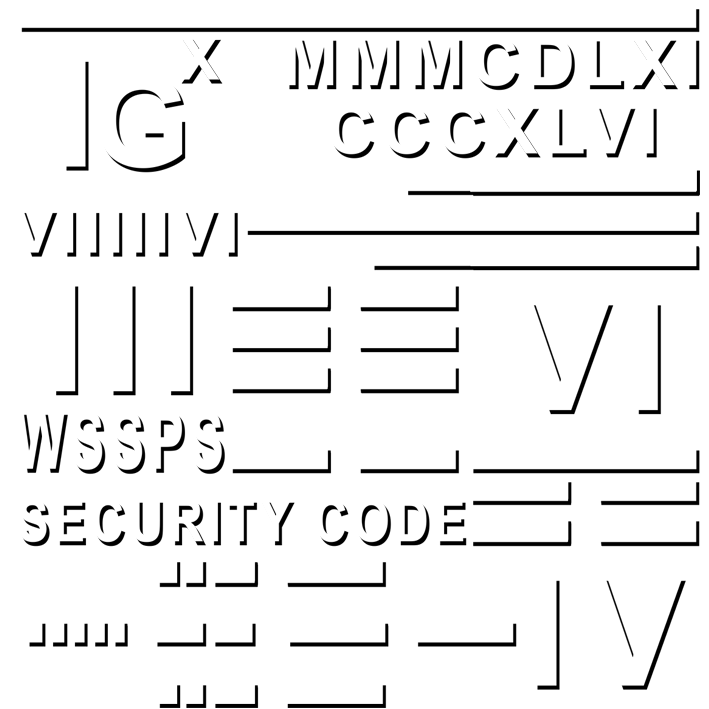
Structural layer (Lines).
Sign / linguistic layer (Word).
Acoustic / frequency layer (Voice Code).
This separation ensures that meaning is not tied to a single representation, and that breaking the system requires simultaneous analysis across all layers.
2. Etching-Based Lines Layer
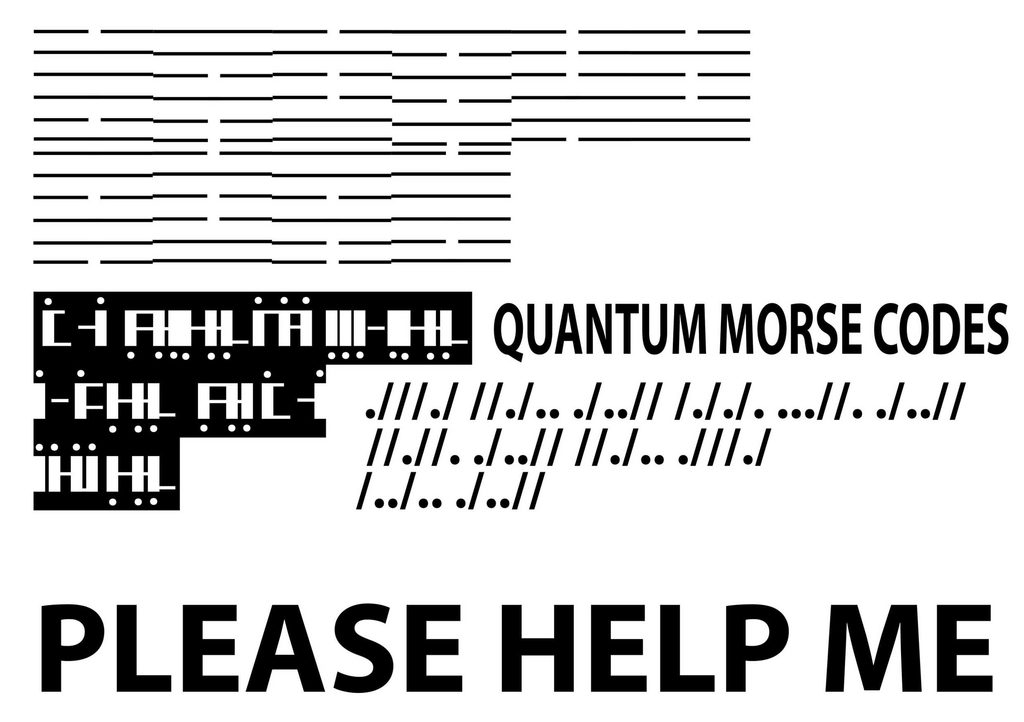
The lines used in this system do not follow the dot/dash rules of classical Morse. Instead, they:
Have non-uniform lengths and spacing.
Depend on a physical etching process.
Contain noise, asymmetry, and process-specific signatures.
As a result, this layer functions not as a discrete code, but as a measurement-based pattern.
Even with full knowledge of the algorithm, exact reproduction is impossible without access to the original source or the etching process itself.
3. The Word Layer and the Use of Obsolete Languages
The Word component is constructed from a combination of multiple obsolete languages.
This choice has clear consequences:
Elimination of live statistical language patterns.
Ineffectiveness of frequency-based linguistic analysis.
Severe reduction in the performance of machine learning models.
In this layer, symbols are not designed for human readability; they function as tokens for conceptual alignment.
4. Frequency-Based Binary Logic
In this system, zero and one are not defined by the presence or absence of a symbol, but by frequency thresholds extracted from etched lines. This implies that:
Data depends on reading, not writing.
Each measurement is potentially slightly different.
The system is practically non-repeatable.
This property makes the encryption appear deterministic while remaining resistant to reconstruction in practice.
5. Fifteen-State Structure and Computational Implications
The system’s fifteen-state frequency outputs:
Lie outside standard binary Qubit logic.
Are not fully compatible even with conventional Qudit models.
Require a redefinition of reading and processing logic.
As a result, direct use of current quantum computers is not feasible without conceptual redesign.
6. Multi-Stage Simplification
The original system was highly complex and has undergone several stages of simplification to reach its current form. The key point is that:
Simplification did not cause structural collapse.
The security architecture was preserved and remains measurement-dependent.
This indicates robustness in the underlying architecture.
7. The Role of Classical Morse
Classical Morse representation does not play a core role in this system.
This layer:
Serves merely as an interface for cognitive and systemic compatibility.
Is a shadow of the primary system, not the system itself.
Conclusion
This system:
Is neither a conventional classical nor a standard quantum Cipher.
Constitutes a process-, frequency-, and meaning-based encryption framework.
Requires simultaneous access to language, physical process, and reading logic in order to be broken.
Algorithm Design: Quantum Morse Codes by
Prof. Abdolreza Shahrabi Farahani